
Three numbers tell the story of the European heat pump market in 2025: 2,88 | 47% | 3-7
2.88 mill. heat pumps were sold across 21 European countries in 2025 (+13% YoY). This was the first rise after two years of decline, yet still 13% below the record sales of 2022 when 3.31 mill. were sold. The recovery was build on uncertain gas prices and made by policy. Governments put incentive schemes back in place and began to take tax off the electricity bill.
And markets reacted. Germany grew by +50%, followed by Denmark (+36%) and Czechia (+31%); the UK set another record with 125,000 units (+27%). Where support was in flux or disinformation spread, sales fell – in France, in Poland, and in Austria (−17%). The nine markets not covered in the past were estimated by EHPA and upped documented sales numbers for Europe to 3.1 mill. heat pumps (See figure 1).
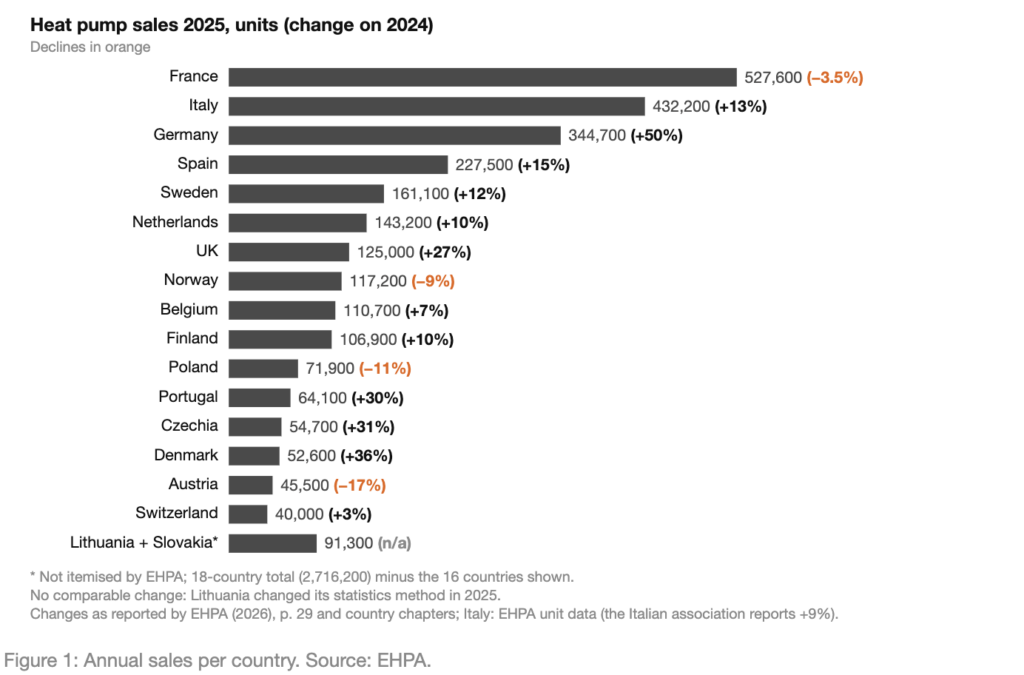
47% of all heat generators sold in Germany were heat pumps. A record achieved only two years after the politicised heating debate. The European average is 33%. The Nordics are at 94–97%; the UK at 7% (with air-air heat pumps not counted). When Europe’s largest heating market moves from exception to normal, the rest of the continent takes note.
3 to 7. This is the multiple describing how much more numerous European countries tax electricity over gas. This leads to higher operating costs for heat pumps. Considering that heat pumps compete best when electricity costs no more than twice as much as gas, taxing electricity leads to lower sales. It is to no-ones surprise that the countries acting like this consistently show weaker heat pump markets.
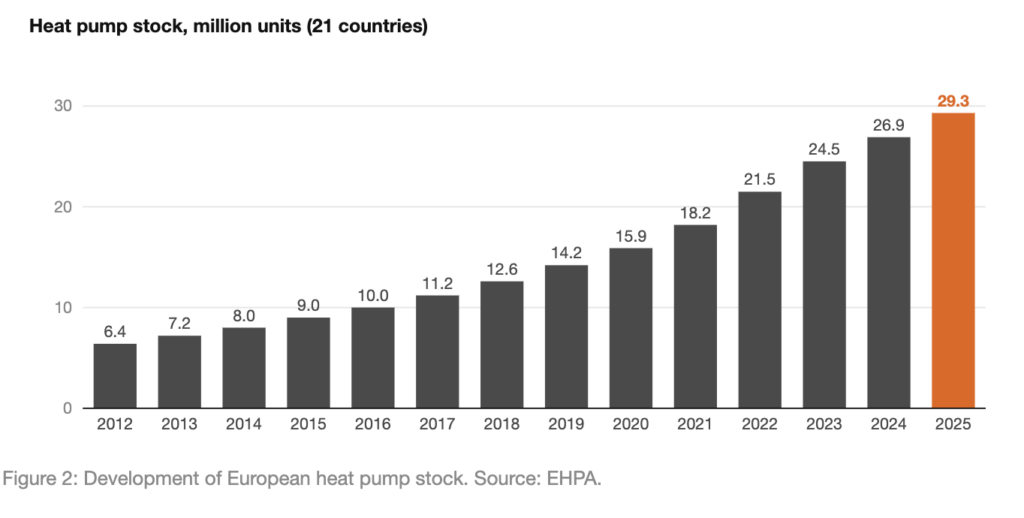
European markets are back. The stock grew 9% to 29.3 million units (see figure 2), nearly one third of Europe’s building stock is now heated by heat pumps.
And the future? Governments need to show a steady hand. Sales return as soon as policy is predictable and prices are honest; they stall the moment either is in doubt.
The technology is ready. The gap is the price signal: an efficient machine cannot show its efficiency on a bill that taxes its fuel several times harder than the fossil alternative.
Technology clarity, backed by subsidies and operational costs lower than those of gas are needed to let growth continue in the near future.
Sources
EHPA (2026): European Heat Pump Market Report 2026. Brussels, 2026 (Executive summary p. 5; Fig. 1 p. 6; Ch. 2 p. 10; market drivers p. 24; Fig. 50 p. 43).