
What is a heat pump
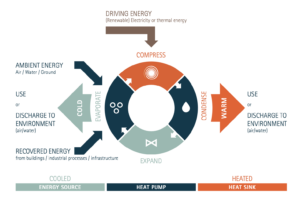
A heat pump moves heat instead of generating it. That is the whole trick – and the reason it beats every combustion system on efficiency.
Around three quarters of the energy a heat pump delivers is taken from the environment: air, ground or water. Only the remaining quarter is electricity to drive the process. One unit of electricity becomes three to five units of heat.
The underlying concept has existed for over 150 years. In Europe, the energy from air, ground and water is renewable by law – defined in the Renewable Energy Directive. A heat pump running on green electricity provides fully emission-free heating and cooling, today.
The same machine cools. Heating and cooling are two sides of the same thermodynamic coin – and buildings increasingly need both.
Frequently asked questions
How does a heat pump work?
A heat pump moves heat instead of generating it. Around three quarters of the energy it delivers is taken from the environment – air, ground or water; only the remaining quarter is electricity to drive the process. One unit of electricity becomes three to five units of heat. Your refrigerator uses the same technology, running the other way.
Do heat pumps work in cold weather?
Yes. Heat pumps heat the majority of buildings in Norway, Sweden and Finland – the coldest corner of Europe is also its most heat-pumped. Modern units deliver full heating capacity at −15°C and operate below −25°C. Performance declines as temperatures fall, which is a sizing question, not a feasibility question.
Do heat pumps also cool?
Yes – heating and cooling are the same thermodynamic process running in opposite directions. A reversible heat pump replaces both the boiler and the air conditioner. If the rejected heat is recovered – for hot water or a shared thermal network – cooling becomes a heat source rather than a waste stream.
Are heat pumps cheaper to run than gas boilers?
A heat pump is three to five times more efficient than any boiler. Whether that shows on the bill depends on the electricity-to-gas price ratio: below roughly 3:1, the heat pump wins on running costs. Several countries still tax electricity more heavily than gas – the biggest single policy failure holding the technology back.
How much does a heat pump cost?
Installed costs for a single-family house typically range from €10,000 to €30,000 before subsidies, varying by country, heat source and building. Most European countries subsidise 30–70% of the investment. The relevant comparison is total cost of ownership over 20 years – where efficiency, carbon pricing on fossil fuels (EU ETS2 from 2028) and grid-flexibility revenues all favour the heat pump.
Do heat pumps work in old buildings?
In most cases, yes. Roughly 60% of buildings can switch immediately; another 10–20% need minor work such as a few larger radiators. Only a minority need deep renovation first. The test is simple: if the building stays warm with a flow temperature a modern heat pump can deliver – today 65–70°C – it is heat pump ready.
Do I need underfloor heating for a heat pump?
No. Underfloor heating raises efficiency because it runs at low temperatures, but ordinary radiators work – sometimes one or two need to be larger. High-temperature heat pumps supply existing radiator systems without changes.
Can heat pumps be used in apartment buildings?
Yes – the myth that no solutions exist for multi-family buildings deserves retirement. One proven architecture: a small heat pump and storage tank per apartment, connected by a thermal network at ambient temperature, coordinated by a smart controller. Each household gets individual metering and control; the building becomes a thermal battery.
Are heat pumps loud?
Modern units run at 35–50 dB(A) – between a library and a quiet office. Regulation is tightening: Germany requires new units to be 10 dB below the EU limit for subsidy eligibility. Exhaust-air and ground-source heat pumps, and apartment units on indoor thermal networks, have no outdoor unit at all.
Is propane (R290) refrigerant safe?
Yes, in units engineered for it. Propane is a natural refrigerant with negligible global warming potential, replacing fluorinated gases across the industry. Charge sizes are small – comparable to a camping stove cartridge – and factory-sealed monobloc designs keep the refrigerant circuit outside the living space or hermetically closed.
How long does a heat pump last?
15 to 25 years – comparable to a gas boiler, often longer, because a heat pump has no combustion, no flame and no flue. Compressors are the main wear part and are replaceable.
What do COP and SCOP mean?
COP (coefficient of performance) is the ratio of heat delivered to electricity consumed at one moment – a COP of 4 means one kilowatt-hour of electricity becomes four of heat. SCOP is the seasonal average across a full heating year, the honest number for comparing units. European products declare SCOP under EN 14825.
Are heat pumps renewable energy?
By law, yes. The energy heat pumps draw from air, ground and water counts as renewable under the EU Renewable Energy Directive. Run on green electricity, a heat pump is fully emission-free heating and cooling – available today, not in a technology roadmap.
Why are heat pumps important for the electricity grid?
A heat pump with thermal storage is a flexible consumer: it can absorb surplus wind and solar power, store it as heat, and pause during scarcity. Grid rules increasingly reward this – Germany’s §14a, Sweden’s capacity tariffs, dynamic pricing in the Netherlands and Great Britain. The heating system that responds to the grid wins.